Wednesday, 29 June 2016

My six favourite European novels

I am supposed to be working on something else (quite urgent) this morning, but the open letter from Mr B's Emporium of Books has urged me to write this post instead, because nothing else seems as urgent right now. (This post is unashamedly personal, and contains public displays of political affiliation, as well as affection).

-

I have been in one of those pessimistic moods of late (and this was before last Thursday), where I question the value of being a writer; that my job doesn't save lives, or put fires out, or shape economic policy. It's one of those times where I can't shake Mishima's statement that the writer is the ultimate voyeur; that we sit around on the fringes of the action, making prurient notes in our notebooks, and then spilling our thoughts, whether they be of schadenfreude, or of joie de vivre, for our own private benefit.

I am lucky. My father founded and ran a group of EFL schools in Kent in the 60s, 70s and 80s. Since my mother worked there too and since my parents couldn't afford a baby sitter, my brother and I would often happily be dragged along to functions of various kinds. I'm sure they felt it was good for us to meet people from other cultures, growing up as we did in a very white part of England, but the accidental wisdom of this cannot be underestimated. My brother and I would stand around while we were shyly introduced to young students from around the world who'd come to learn English at my Dad's schools. I have fond memories of meeting many German, French, Italian, Swedish, Russian and Greek students amongst others from Europe, as well as people from further away: Iranians, Iraqis, Saudis, Nigerians, Egyptians, Japanese and so on and so on, and without fail, all I can remember are happy faces, warm smiles, and friendly handshakes. I learnt very early on that there is nothing to fear in the Other, per se; that there are kind and generous people across the world.

So today, and focussing for obvious reasons on Europe, here are my favourite European novels.

FINLAND (written in Swedish)
The Summer Book - Tove Jansson

As wonderful as Jansson's Moomin books are, my favourite of her works are The Summer Book and The Winter Book - both depicting life on one of the myriad small islands in the Baltic between Sweden and Finland, and the relationship between an elderly artist and her granddaughter. Somewhat autobiographical, utterly touching, with deceptively simple writing that lingers long.


ITALY
Foucault's Pendulum

His best known novel is perhaps The Name of the Rose, and as 'fun' as that book is, Eco's ability to combine elements of the thriller, the literary novel and historical fiction are never better displayed in this story that's what the Da Vinci code might be if it was (way) smarter and had its tongue in its cheek. The book every tin-foiling, bunker-building, survivalist-loving conspiracy theorist ought to read.


FRANCE
The Outsider - Albert Camus

Sadly, I have only ever managed to read a handful of books in their original language, one being The Summer Book, above, and another being this classic French novel of existential horror, and simmering racism. You'll notice that what links them both is that they are very short. But short novels are often the most powerful - their content is distilled, and hit you harder as a result.


SWITZERLAND
The Vampire of Ropraz - Jacques Chessex

Loosely based on the true story of a serial killer in the Jura Mountains in the early days of the 20th century, this is another short book that punches above its weight, using distancing prose in an almost reportage style that somehow makes the events it describes even more horrific. 


POLAND
Who was David Weiser? - Paweł Huelle

So much more than a coming of age story - this mysterious tale is a book about tolerance, friendship and faith. Set in the Poland of the late fifties, a country still very much living with the outcomes of war, it's the story of a strange, charismatic boy with powers no one understands and whose disappearance is never satisfactorily solved. 


GERMANY
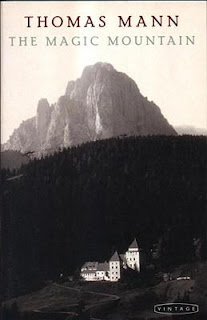
The Magic Mountain - Thomas Mann

In my humble estimation, this is the finest novel ever written and I am going to say nothing about it (or we'll be here all day) apart from the thought that this masterpiece is set in the seven years up to 1914 and therefore the approach of war that will see Europe run with an ocean of blood – to paraphrase Jung's nightmare that was a premonition of European conflict – is never too far away. Look away now if you don't want to read the final line of the book (in the translation by H.T. Lowe-Porter).

"Out of this universal feast of death, out of this extremity of fever, kindling the rain-washed evening sky to a fiery glow, may it be that Love one day shall mount?"


Think it's too much to intimate that we could see war again in Europe? That's what they said after the war Mann was writing about. It's what we said after the second war too. And after that horror, we founded a European community in which conflicts would be settled in debating chambers and courtrooms, as opposed to gas chambers and battlefields. Actual warfare was assumed to be a thing of the past, and then came the genocides of the wars in the former Yugoslavia, and that was only 20 odd years ago.

To end, I've just returned from the American Librarian Association's conference. It was heartening to see how many people were not follwing the EU referendum, but as horrified (and amazed) by the result. They see the obvious implication for their looming presidential election this November, and realise that the same mentality that voted to leave is the same mentality that may elect a ranting racist to the most powerful job in the world. Driven by the same kind of fear-mongering, this is a mindset that refuses to accept that we live in a globally-connected world. We can either enjoy and profit from that cross-culturality, or we can live in fear and conflict.

Had my father lived, (he would have been 100 this year, born during a Zeppelin raid in the first world war), he would be weeping to see the events of the last few weeks.  When he died, my mother asked me to sketch a design for a sundial to be set in the grounds of the college he created. The block of slate was duly made in Wales, and dispatched to Kent, inscribed with words she chose; under his name and dates is the following: 'This centre of international friendship is his memorial'. His was work that I find it easy to see as important - not only did his schools teach people English, I saw how they fostered tolerance and understanding.  

In my jet-lagged haze, I am trying to tell myself that books are important. That they do have a place in all this; that perhaps, in the long run, they really are the most potent force of all, because they contain ideas, ideas that can change the planet. We know this to be true, or freedom of speech wouldn't be banned in more than half the nations on Earth. As Percy Shelley said, 'poets are the unacknowledged legislators of the world'.

So who's right - Mishima or Shelley? Are writers insensitive voyeurs, or honourable philosophers? I guess my view on this can be summed up in this thought about writing by another poet, John Keats, who said a writer spends his or her life trying to work out whether they are the healer or the patient. 

The answer, of course, is both.


Monday, 6 June 2016

Saint Death


Saint Death plays out on the borderland of Mexico and the USA. It's the story of Arturo, who has one night to play a deadly card game to save his friend Faustino's life – Faustino having fallen into working for a street gang in Juarez, connected to the drug trade.

It's a story about power, lies, and friendship, and it's about what happens we be build fences between rich communities and poor ones, and then try to pass things of value (i.e. drugs, guns etc) across those borders.

Hovering in the background, never too far away, is the mysterious figure of Santa Muerte, (Holy or Saint Death), a 'folk saint' of growing popularity in Mexico and parts of the US. She's a figure of disputed origins and disputed significance, and is worshipped by many different people from all sectors of society: the poor, the powerful, drug lords, prisoners, prison officers, police, prostitutes... the list goes on and on. If you're interested to find out more, this video from youtube is as good a summary as any of the 'white lady' (who goes by many, many names).


There's some confusion over the various icons of death that Mexico employs. 

Santa Muerte is a (female) skeleton in a shroud, often depicted holding a scythe in one hand and the world in the other (the scythe suggests the more European-in-origin figure of the Grim Reaper but the 'bony girl' is a distinct personality).

(Other figures, such as general 'calavera' (skull) icons like the one on the cover of my book, and the girl known as La Catrina, are also separate entities.)


You can read an extract from Saint Death on The Guardian's website. It will be published on October 6th 2016 in the UK and April 2017 in the USA.


Thursday, 26 May 2016

The Ghosts of Heaven - cipher solved

This post is probably only of interest to anyone who got to the end of The Ghosts of Heaven and wondered what the page of numbers and letters at the end of the book was all about; the page in question being this:


A lot of people wrote to me, asking if it was a cipher, and in response to that, I posted this in April of 2015, just over a year ago, and around eight months after the first publication of the book in the UK. In short; yes, I said, it is a cipher, and no, I'm not going to give any clues about how to solve it; other than stipulating that everything need to solve the thing could be found in the book itself.

I wasn't giving clues because I like being mean, in fact it was very hard sticking to what I had decided; namely that I wanted to see how long it would take for someone to solve the cipher with no help from me at all, and I could be certain that help could come from nowhere else because no one (not even my editors nor family) knew what it was all about. (Note, you can only get away with this kind of thing if your editors trust you).

It was, therefore, with great happiness a couple of days ago that I received an email from one Erik Kjellgren of Texas, because he's cracked it: he sent me the solution. So as to give him full credit for his work, I asked him for his own words on how he did it:

"Whenever I read a book I have this habit of reading all of the additional information inside of it before beginning on the main content. In the case of The Ghosts of Heaven, this involved your spiral definition, the introduction, and turning to the back to see the cipher you had left. At the time I didn’t think much of it, maybe assuming it to be an unnecessary filler page, and so began reading. I didn’t think of the cipher again until I reached page 310, and a series of artists were mentioned. I took AP Art History this last year and we learned, of course, about Van Gogh, Rembrandt, and The Spiral Jetty. I was completely unaware of Final Words by Rijndael, and so I googled it, only to find the Rijndael Key Schedule. I read through the Wikipedia page and was reminded of the final page of the book. I then googled “The Ghosts of Heaven Code” and was led to your blog post, saw your warning, and saw your hint of it all being available in the book. This basically confirmed for me that I was on the right track. I then googled “Rijndael Decipher”, and found http://rijndael.online-domain-tools.com/ (honestly this felt like cheating, but I can’t imagine anybody deciphering that code by hand). Using that resource, I realized that I only needed the mode and the key. I decided to skim over the beginning of the third quarter to see if I had missed something, and saw that it was said on page 290 that a woman had a “CBC of at least 256”. CBC was clearly what I needed for the mode, and because of this I also needed the initial vector in addition to the key. The key was easy, however. From the Wikipedia page I knew I needed a 16-digit key, and on page 321 Bowman gives a code of the first 16-digits of Phi. I decided that must have been the key (quite fitting seeing as Phi is sort of the key to the entire novel). I assumed the initial vector to be zero just out of hope, ended up being correct, and was able to put in the characters from that page 256 digits at a time to reveal the message."

This makes me very happy, as I said, because this are exactly the steps I hoped someone might take to figure it out, and Erik explains it all so succinctly there is nothing left for me to add. Except, perhaps, the solution itself... which is no great earth-shattering secret, just something I was thinking as I wrote the book, but nevertheless something which I hope makes the bleaker parts of it, and life, seem much less so.

"'The best people possess a feeling for beauty, the courage to take risks, the discipline to tell the truth, the capacity for sacrifice. Ironically, their virtues make them vulnerable; they are often wounded, sometimes destroyed..' So said a writer whose work has always been important to me. I would only add one thing; there are those who are destroyed, those for whom life is simply too strong, but as long as they are remembered in the hearts of their loved ones, they shall not die, but shall live forever..."

Not that I'd offered one, but a small prize is being dispatched to Texas very soon. Thanks, Erik, for making my day.

Friday, 18 December 2015

New books

I knew it was a while since I had posted; coming back here today I see it's six months. Oops. I have some lame excuses about moving house, settling in to a new country and so on, but who's buying it?

The truth is usually that I didn't have anything to say, and in that case, it's better to keep silent. But I have been writing, and working on various stages of different books, and so here's a quick post of what's happening, and what books I hope will appear in 2016.

Have a very good and peaceful holiday.

Mister Memory
My second novel for the excellent people at Mulholland, Mister Memory is scheduled for July 2016, and is the final realisation of an idea I've tried to work with for a very long time, over a decade in fact. Inspired by the real story of Solomon Shereshevsky, it's the story of a man with a perfect memory. Shereshevsky was a Russian living in the early 20th century, who lived a pretty sad life due to his inability to forget. Mister Memory recounts the tale of Marcel Despréz, working in the clubs of Pigalle, Paris at the end of the 19th. It's a tale of murder and of power, but above all of the fact that in order to function, we have to find the balance between memory and forgetting.


Saint Death
October will (I hope) see the arrival of my next book for Orion. I've just finished the first draft, and am trying not to tinker with it for a while. It's set (literally) on the border of Mexico and the United States. It's about death, love, money, power, guns, gambling and lies. It's about three friends who are part of the kind of community that suffers greatly from the narco wars.

Blood Red, Snow White
If you're reading this in the States, however, it's more likely that the next YA book released will be this true story about an English writer and his small but significant role in the Russian Revolution. You can read more about it here.


Snow
Finally, I'm now working on a short book/long essay about one of my favourite subjects, for Little Toller. This is a beautiful series (have a look here) and I'm really happy to be adding to it. It's possible to write about anything, anywhere - but it's fun when what you're writing about is all around you. As I write these words from my new writing room in our new house in the French Alps, with snow lying thickly on the ground, my work as a writer is made that little bit easier.


That's it for 2016, but looking further ahead, 2017 should hopefully see the following books.


Voyages in the Underworld of Orpheus Black
After Dark Satanic Mills, my brother and I wanted to work on something else. This book is the result. It takes the Orpheus legend and recasts it during the Christmas of 1944 in London. Harry Black, conscientious objector, artist, is working as a fire warden as the doodlebugs and V2s pound the city towards oblivion. It's part novel, part graphic novel. There is exciting news about the artist for this one, but I'm not allowed to say who that might be, as yet.

Scarlett Hart: The Tentacles of Terror
Another collaboration, this time with my great friend Thomas Taylor. We've both posted bits and pieces about this long-running project for First Second Books, which has been beset by delays. We're both now happy to say it looks like it's back on track and I hope 2017 will see it emerge. Thomas is doing an amazing job with the art, he's a total natural for comics, and I can't wait to see the finished thing.


Friday, 12 June 2015

A short tale of international harmony

Some good people at Lenape High School, New Jersey, USA wrote to me asking if I knew whether Braille copies of She Is Not Invisible were available in America. They've chosen the book to be their One Book/One School title for 2015/2016 and wanted to make it accessible to a couple of blind/visually impaired students. The whole point of One Book/One School is to make a book available for everyone in the community to read, after all.


Sadly it seemed that there isn't a Braille edition in the US, so I thought it was worth asking the RNIB over here in the UK if they could help. They'd produced a Braille edition for publication day of She Is Not Invisible back in 2013, but I thought there might be some obstacles. I wasn't sure if UK Braille and US Braille are the same, for one thing, and for another thing Braille books are VERY expensive to make. That's the main reason why so few Braille books are produced (less than 1% of published titles) and that's a shame because it is terrible that being blind should stop you from having access to as many books as a sighted person. Yes, there are other options, and yes, not every blind person reads Braille, but when I spoke to various people when I was writing She Is Not Invisible I couldn't help but feel that some more money to make more books accessible to blind readers through Braille would be very welcome.

Fortunately for me, and for Lenape High School, the RNIB are just a truly wonderful organisation, and though their school is all the way over the ocean in another country, they made the decision to gift a Braille edition of the book to the school. (It turns out that UK and US Braille are almost identical: I'm told the differences are only when you come to write it, not read it).

The impact of this act of generosity is not just of benefit for the blind students, and to explain why, here's what Jaime Fauver, Media Specialist at Lenape High had to say when she received the book:

"It arrived yesterday and we are so excited about it! I spoke with our special education teachers and they are also excited - not only for students who are blind or near blind and read Braille but also for the other students in the MD classes (multiple disabled).  These students in this class suffer from a range of disabilities and the teachers are going to use this as an opportunity to discuss differences and unique challenges.  When we took the book to the classroom today, all of the students were fascinated and intrigued.  Most of the school materials for our partially/fully blind students are audio; however they know how to read Braille (we just didn't have the resources). The teachers are going to spend the last week of school turning this into a lesson about diversity and acceptance and how interesting and exciting each of the students' unique traits are!"


Diversity and acceptance. What better goals could we aim for?

Finally, the Photography II students at the school made a range of posters to advertise the book around the school, and put together this short video to showcase their work. It's worth looking at: there are some great interpretations in there, and some cover designers in the making, I think.


Finally, I want to say a massive thank you to Cathy Wright, Librarian at New College, Worcester for her ongoing advice when I don't know something about the unsighted world, to Lenape High for doing such good work with the book, and to the RNIB for their wonderful act of kindness.

Wednesday, 29 April 2015

The Ghosts of Heaven numbers

I'm writing this post for those that have read The Ghosts of Heaven and have wondered about the page of numbers at the close of the book. I'm getting emails asking me to explain it, so it seemed a good idea to write this post so that I have somewhere I can direct people to. If you haven't read the book, I wouldn't bother reading on.

This is the page in question:


Most of the people writing to me by email have guessed that it is a code of some sort. To be precise, (and I use all my words very precisely), in cryptographic terms it's not a code, it's a cipher. I have been asked to explain what it means, but I don't want to do that for a number of reasons, the most important of which is, as Stanley Kubrick said, 'You tell people what things mean, they don't mean anything anymore.'

I am interested to find out if anyone can solve it, and how long it takes for that to happen if so, without any help from me. This blog post will be the only thing I have to say on the matter. I am the only person who knows what it means and how to decipher it - not even my editor or closest family know, so the answer will go with me to my grave. If this is irritating, I'm very sorry. One or two people have been rather rude and angry seeming in their emails to me, which I suppose I shouldn't be surprised about. Someone asked me what right I had to put something in a book they couldn't understand. Hmm. There's a worrying thought for you.

Anyway, I will say here what I have said to anyone who has written to me so far.

1 - Yes, it is a cipher.
2 - And yes, it can be deciphered: everything needed to do so is contained in the book.
3 - As I said above, I use my words precisely.

If you don't understand it, or if you can't be bothered to try to work out what it means (and let's be honest, why should you be?) then that's fine. Not everything in life can be, or has to be, understood. Perhaps that's one of the things I was trying to suggest with the book.

To quote the poem by James Sarafian that I used a part of in The Ghosts of Heaven, and which appears in full in Killing the Dead:

"It is enough to know that not to know is enough.
It is enough not to know."


Thursday, 26 February 2015

YA IS NOT, NOR SHOULD IT BE, A GENRE

In the way that often happens, a seemingly chance series of conversations and references suddenly coalesce in your awareness, and something that’s been nagging at you as an indefinite feeling becomes realised in the broad daylight of your consciousness.

Over the past few weeks I have heard several references to the ‘YA genre’. I’ll come back to that nomenclature later. During the same period I have been witnessing a stream of books sent to me to review, or quote for, every single one of which was written in the first person present tense, with a certain breathless intensity of oh-my-weird-little-life.  Usually there’s cancer, death, divorce etc. thrown in to the mix. Let’s be clear, there’s nothing wrong with writing in the first person present in itself. Many good books have been written this way. Well, one or two, at least. But it made me wonder why so many books for young adults are being written in this way.

Many things determine the choice of narrative voice in a book; but I believe it’s of utmost important that whatever narrative voice is chosen, it is selected for what it can do for the book; how it will work technically, as well as the emotional impact it provides. Here’s an example of how the first person can go wrong; the most obvious limitation to it is that since you as the writer only have your protagonist’s voice at your disposal you can only convey to your reader things that the protagonist knows. That’s okay if the plot of your book will work fine that way, but problems ensue as a writer requires their reader to know things that the protagonist doesn’t. A very smart writer can find ways of signalling thing to the reader of which the protagonist themselves is unaware. Sadly the writer of the latest of such books sent to me did not seem to have coped with these limitations. The result was a text in which the protagonist was constantly overhearing things through walls, eavesdropping on phone calls, standing in doorways but remaining somehow unseen, and in the very best case of all declared ‘if I was in a bad movie I would jump into the closet now so I could hear their conversation. So, I jump into the closet.’ I’m actually not kidding.

So what? Well, I’m fearing that the world of YA books is eating itself. That its horizons are diminishing, its ambitions declining. Again, for the sake of clarity, I am not saying there are no adventurous new books for teenagers being published. There clearly are and you can of course tell me what you think they are in the comments, if you wish. That’s not my point. My point is that it feels as if the vast majority of new books for young adults fit into one of two broad types; there is a) what we might call The Twilight Games, and there is b) the breathless first person novel, or BFPN as I have started to call it, as described above.

And that’s why I think using the term YA as if it’s a genre is not helping matters. As anyone who’s ever heard me speak will know I am very wary of age ranging. Yes it’s inevitable, but overall I think it does more harm than good. At most, that’s all ‘YA’ should mean – a way of placing books in shops with a ROUGH idea that the titles may be appropriate for teenagers. What YA most definitely should not be is a genre. Genres exist; Fantasy, Sci Fi, Chick Lit, Dystopia etc etc etc. Fine. YA should not be on this list. Genres are by definition limiting.

For me, the hallmarks of the teenage experience are these: experimentation, rebellion, the thirst for originality. These things are what attracted me to write in the way I have been in the first place, and when I began, the term YA wasn’t really in use; they were just books for teenagers. They went in a certain section in the bookshop, and their breadth and variety was wonderful. Here, a book like Cider with Rosie could be shelved alongside Animal Farm alongside The Outsiders alongside The Chocolate War alongside Red Shift.

I fear that we are now at risk of operating in a ‘YA world’, in which we all; writers, teachers and students of creative writing, editors, agents, publishers are self-defining what a YA book is, and it seems that that definition is narrowing. It seems very hard to see beyond the two dominating behemoths I’ve listed above. As the book industry continues to adjust to a not-so-brave new world of online retailing, and so becomes ever tougher, publishers are under enormous pressure, and thus increasingly are tempted to make ever more timid decisions. As some will know, I worked in publishing for 18 years; I have seen such timidity occur, and breed: ‘We can get this book through acquisitions because it’s a bit like such and such’.

Perhaps I’m worrying about nothing. Perhaps all this just goes to show the validity of that old adage ‘80% of anything is rubbish’. And that that was always so. And if that’s so, then so be it. Let’s just try and ensure that the 80% doesn’t creep up to 95%.

It takes a bold publisher, one who believes in what they are doing, someone with the confidence of experience, or indeed of youth, to champion a book that is utterly unlike everything else that’s flooding the market. But it must be done, above all, in thinking about books that younger minds will respond to, it must be done, because the desire for the original is what the experience of being a teenager is all about.


YA is not a genre. Referring to it as such will only diminish us all.